How & Where to Sell 3D Prints (Etsy, Craft Fairs, and Local)
Where to sell 3D prints and how to price them — a channel-by-channel guide for HueForge makers comparing craft fairs, Etsy, local shops, and social, plus the legal basics.
Quick Answer
You can sell 3D prints on Etsy, at craft fairs, through local shops, or on social — and the right choice depends on what you make. HueForge wall art tends to sell better in person, where buyers can see the light effect, than as an online thumbnail. Price on value and time, not filament weight, and only list subjects you actually have the right to sell.
You've got prints worth selling. Now the question is where — and nearly every guide gives the same answer: "list them on Etsy!" For a lot of HueForge work, that's the worst first move. A filament painting's whole appeal is what light does to it, and that effect dies in a two-inch thumbnail wedged between a thousand resin dragons.
Where you sell should follow what you make. Some prints move online; HueForge wall art usually moves in person. This guide walks the real options — craft fairs, Etsy, local shops, and social — with the fees, effort, and fit of each, plus how to price so you're not working for filament money.
It covers the main sales channels compared, how to price a print, the Etsy question specifically, and the legal basics of selling.
Where Can You Actually Sell 3D Prints?
The four channels that work for solo makers are craft fairs and markets (in person), online marketplaces like Etsy, local consignment in shops and galleries, and direct social selling. Each trades fees against reach and effort in a different way, and the best fit depends heavily on what you're selling.
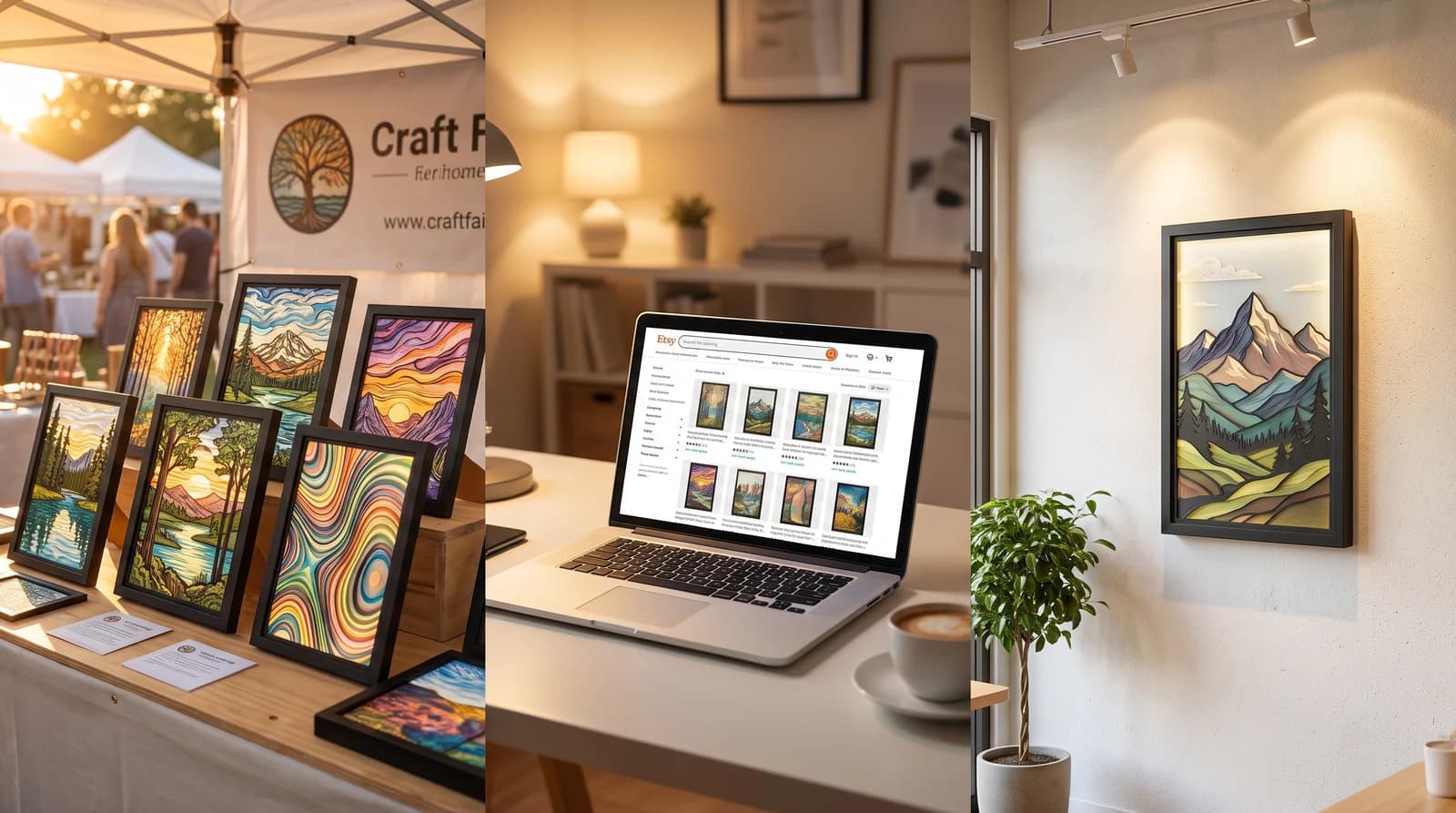
Craft fairs and markets are the strongest channel for HueForge art. Buyers see the light effect in person, you get instant feedback on what's working, and there's no platform cut — just a table fee and a day of your time. If your work depends on being seen, this is where it sells.
Online marketplaces like Etsy give you the widest reach, but the reach comes with saturation, ongoing fees, and a format that's unkind to art that depends on physical presence. It has its place — more on that below.
Local shops, galleries, and cafés work on consignment: you place the pieces, they take a cut of anything that sells. Low ongoing effort once the work is on the wall, but you split the revenue and give up control over how it's displayed.
Direct social selling — Instagram, TikTok, local Facebook groups — has the lowest fees and builds the most direct relationship with buyers, but you become the entire marketing department.
The "best" channel isn't universal — it's the one that matches your product and the time you have. Most makers do best with a primary in-person channel plus one online channel as a catch-all, rather than betting everything on either.
How Do You Price a 3D Print?
Price on value and time, not material. Start from a floor of your material cost, plus a real hourly rate for the active labor, plus a share of overhead. Apply a margin, then check the number against what comparable pieces sell for in your channel. HueForge wall art almost always prices well above its filament weight — the buyer is paying for the image, not the plastic.
Take a wall piece around 200×200mm as an example. The material is a few dollars (see The Hidden Cost of Filament for the real number once you count purge, failures, and partial spools). Then add active labor — the design work, the filament swaps, the finishing and framing — plus overhead like printer wear, failed prints, and your booth or listing fees. Margin goes on top of all of it. Price the small stuff differently: bookmarks and magnets are priced for the $8-to-$15 impulse grab, not by this full formula.
Then sanity-check against the room. The same piece prices differently at a rural craft fair, an urban art market, and an online shop full of global competition. A pricing formula sets your floor; the market sets your ceiling. If buyers won't clear your floor, the fix is usually better subjects or a better-matched channel — not cutting your rate until the work is free.
This is general guidance, not financial advice. Factor in your local taxes and any platform or booth fees when you set prices.
Can You Sell 3D Prints on Etsy?
Yes. Etsy explicitly allows 3D-printed items, and you can sell either physical prints or your own digital design files there. The real questions aren't whether you can — they're whether Etsy fits HueForge art (mixed) and whether your subjects are legal to sell (often the deciding factor).
For the direct answer: selling 3D prints on Etsy is allowed, and the platform takes a listing fee plus a cut of each sale and payment processing. Exact numbers shift over time, so check Etsy's current fee schedule before you price — don't build your margins on a figure from an old blog post.
On fit, be realistic. Etsy rewards volume, sharp product photography, and search optimization. HueForge wall art can work there, but only if your photos capture the backlit effect — otherwise the thumbnail undersells the piece and it gets lost in the grid. The digital-file route is worth considering too: selling your own designs sidesteps shipping and print labor entirely, though it puts you in a different competition based on design and marketing rather than printing.
Etsy's reach is real, but so is its saturation and its cut. For many makers it works best as a supporting channel behind in-person sales, not the flagship. And it changes nothing about the rules on what you're allowed to sell — a marketplace listing of a copyrighted character is still infringement. Best 3D Prints to Sell covers which subjects are safe in depth.
What Do You Need to Sell 3D Prints Legally?
Two things: the business basics for your area — registering as a seller, handling sales tax, and any vendor permit for fairs — and clean intellectual-property footing, meaning you only sell prints you actually have the right to sell. The IP side is where most maker shops run into trouble.
Keep the business basics local. Most places require you to register as a seller and collect sales tax above some threshold, and craft fairs often need a temporary permit — but the specifics vary too much to generalize, so check your own local rules rather than trusting a one-size answer.
The IP part is the same principle that runs through everything we publish on selling: a downloaded file, free or paid, doesn't license the underlying character. Selling prints of licensed IP — Pokémon, Marvel, Disney, sports logos — is infringement, and it scales into real risk as your shop grows. The safe ground is original art, public-domain and nature subjects, licensed source material, and customer-supplied images for commissions.
Only list what's yours to sell
A cease-and-desist or a marketplace takedown is unlikely when you sell a few prints to friends, and much more likely once you're visible enough to notice. Build the shop on subjects that can't be pulled out from under you. For the full setup — registration, startup costs, and a first-90-days plan — see How to Start a 3D Printing Business.
This isn't legal advice — copyright, trademark, and tax rules vary by country and by how you sell. If you're building a real shop, get a lawyer's read before you list anything you didn't create.
Where to Go From Here
The channel only matters if you're selling the right pieces, so start with Best 3D Prints to Sell for the subjects that convert. For the full business setup — registering, startup costs, and the 90-day plan — see How to Start a 3D Printing Business.
Two supporting guides help you sell more per piece: Displaying & Photographing HueForge Prints — because a booth is a display problem, and a well-lit print at eye level stops people in the aisle — and The Hidden Cost of Filament, so you know your real floor before you set a price.
Sell where buyers can see the light hit it, price like your hours count, and only list what's yours to sell.